Revolution 1989: Victor Sebestyen
This post looks at chapter 16 in Sebestyen's Revolution 1989. It focuses on the Romanian tyrant Nicolae Ceausescu and the last years of his regime.
 |
| Map Showing the Extent of the Soviet Influence After World War II |
Sebestyen's readable and fluent account sets the scene on the 26th of January 1986, the birthday of Romania's leader, Nicolae Ceausescu. Approximately three years before his execution. Romania was one of the satellite states of the Soviet Empire and like many states of the Eastern Bloc, it was characterised by a brutal regime under the leadership of Ceausescu. He was known by progressively ridiculous titles such as "The Giant of the Carpathians" and "The New Morning Star." People heaped praises upon him. Poet Adrian Paunescu writes "...therefore it follows that the source of sunshine does not come from Abroad, but that we have our very own Sun emerging from our capital city Bucharest..." However the tone of the poem is so over the top that it seems to be written as a mockery. Ceausescu and his wife Elena welcomed the praise and flattery, it is unlikely that anyone else believed it, but to openly criticise the leader would result in imprisonment or execution.
 |
| Nicolae Ceausescu |
The story of Romania under the control of Ceausescu is one of brutal regimes, complex bureaucracy and a police force purely created to control the population and instill fear in the citizens. Originally, the beginning of Ceausescu's regime was a welcome change. Born in 1918 to a peasant family, the despot would eventually end up in prison, where he was educated by Marxists. After leaving prison, he rose to power in the Communist Party and in 1965 he succeeded Gheorhiu-Dej as leader of the Communist Regime. Ceausescu's rule can be divided into two different eras. For the first six years of his rule, Ceausescu undertook measures such as encouraging private enterprise and limiting censorship. However, the next eighteen years were marked by increasingly harsh measures. Inspired by the likes of fellow despots, Kim Il-Sung and Mao Zedong, Ceausescu returned to Bucharest determined to achieve the same level of worship and deification. From this point on, Ceausescu was increasingly praised and feared by his people.
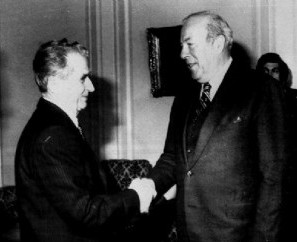 |
| Nicolae Ceausescu shakes hands with George Schultz, United States Secretary of State during a visit to the United States |
Sebestyen primarily focuses on the end of this era and the policies and institutions Ceausescu implemented. He does not look at the consequences of these policies, among them the revolt of the Romanian population and subsequent execution of Nicolae and Elena Ceausescu, however the chapter focuses on the bizarre actions and goals of Ceausescu in his later life. Ceausescu wanted to create an economy less reliant on the Soviet Union and free his country from debt to foreign creditors. In theory what was a good idea turned out to be disastrous. Along with the strict food rationing that meant many Romanians struggled to provide for themselves and their families, access to energy was limited too. Instead, the majority of produce and energy was exported to countries like Germany and Italy. Modern technology was replaced with more primitive tools. Ceausescu may have reduced foreign debt, but this resulted in the deaths of many people through starvation and hypothermia due to poor living conditions and freezing temperatures in homes in winter.
Alongside these restrictions, a condition of fear was created and encouraged. The Securitate was Romania's police force. They operated on a system of propaganda and rumours and interrogation. The Securitate had huge power and influence, and it is estimated that "one in every thirty Romanians was working as a Securitate informer..." There are no official records, so this may or may not be true, but the rumour was enough. Citizens did not know whom they could trust whether it be neighbour, shopkeeper or even family. Although not illegal, talking to foreigners was more trouble than it was worth. Alex Serban said that "They (the Securitate) did not have to keep a watch on people for everybody thought they were being watched." The fear and paranoia meant that organising a resistance would be most difficult and it was this fear that prevented many from doing so. There were strict regulations around the ownership of typewriters so any written dissent could be traced to the owner of the material. Ceausescu demonstrated his ruthlessness by jailing and executing the leaders of an industrial strike twice. Sebestyen says that the despot often quoted the mad Emperor Caligula. In any case, those who committed crimes of a political nature were dealt with quickly, even to the extent where Ceausescu's son Valentin and daughter Zoia had their lives ruined by his regime.
In 1986, Ceausescu's methods grew even more barbaric with the introduction of his new laws concerning abortion. He would stop at nothing to achieve his goals. He raised the age of abortion to 45, banned contraception and reduced the age of marriage for girls to fifteen. All this was done in an effort to raise the population from 23 million to 30 million. To reach this goal, Ceausescu implemented measures that meant women were forced to go to clinics where they were examined for evidence of pregnancy or pregnancy termination. Women who miscarried or weren't pregnant were questioned by the police. Numbers suggest that almost 10,000 women died due to Ceausescu's policy, additionally, to Ceausescu, it did not matter what happened to the children after they were born. As many families could not afford the burden of another mouth to feed, thousands of children ended up abandoned. While the Ceausescu's relished in praise and fame, the people of Romania were becoming increasingly impoverished and angry. Ceausescu's new law was just one action among many that set in motion the events leading up to 1989. For while he succeeded at repressing the voice of the people for twenty four years, everything changed on the 16th of December 1989.
In 1986, Ceausescu's methods grew even more barbaric with the introduction of his new laws concerning abortion. He would stop at nothing to achieve his goals. He raised the age of abortion to 45, banned contraception and reduced the age of marriage for girls to fifteen. All this was done in an effort to raise the population from 23 million to 30 million. To reach this goal, Ceausescu implemented measures that meant women were forced to go to clinics where they were examined for evidence of pregnancy or pregnancy termination. Women who miscarried or weren't pregnant were questioned by the police. Numbers suggest that almost 10,000 women died due to Ceausescu's policy, additionally, to Ceausescu, it did not matter what happened to the children after they were born. As many families could not afford the burden of another mouth to feed, thousands of children ended up abandoned. While the Ceausescu's relished in praise and fame, the people of Romania were becoming increasingly impoverished and angry. Ceausescu's new law was just one action among many that set in motion the events leading up to 1989. For while he succeeded at repressing the voice of the people for twenty four years, everything changed on the 16th of December 1989.
 |
| Uprising in Bucharest |
The rest of the world may have turned a blind eye to the situation in Romania, but it was growing dire. The Romanian peoples' suffering manifested itself in anger and violence. The first protest began in Timisoara on the 16th of December. Not long after, in Bucharest on the 21st of December 1989, Ceausescu began a speech but was attacked by the crowds. The rebellion had begun and the Ceausescu's attempted to flee the country. They were unsuccessful, as they were captured by the military. The trial was short and the pair were charged with "...genocide... and tyrannizing the soul of the Romanian people." The previous statement is a direct quote from the trial's transcript. Nicolae and Elena Ceausescu were executed by firing squad on the 25th of December 1989. Sebestyen's account vividly portrays the last years of a cruel and ruthless tyrant, and how such a hated man managed to stay in power for twenty four years.


Good summary Ella! And good use of links to external material. I didn't know Paunescu's poems were available on the web!
ReplyDeleteOne question: did the encouragement of flattery and adulation help Causescu retain power, or was it only useful to stroke his ego? Do you think he knew that only very few people believed the flattery?
I think what enabled Ceausescu to retain his power for so long was the element of fear he created through the Securitate and the arrest of those deemed to be 'political criminals.' I think he used the flattery as a tool, to weed out opposition and as an excuse to arrest them.
ReplyDeleteThe laws surrounding the typewriter suggest that he was aware that few people saw him in a favourable light. It's possible he eventually believed in the flattery, but considering the state of the country I think it would be very hard to believe that the people upon whom you brought poverty are sincere in their praises. Ceausescu just used his power to arrest those that didn't.
It might be important here to reflect on the prologue of the book in relation to chapter 16 which outlines the final hours of Causescu's life - having tried to flee, accused of things they apparently didn't do, then executed by firing squad and buried separately in unmarked graves. Really shows how angry and desperate the people became huh?
ReplyDeleteRead the last chapter - it tells the whole gripping story of the revolution in Romania. Really worth reading. But yes, people were quite angry with Ceausescu; some Romanians used to refer to Bucharest as "Ceaushwitz".
DeleteWhen doing my research I found some footage of their trial and execution http://www.youtube.com/watch?v=MhTflHfPhgc It's really interesting and by no means am I trying to excuse their actions, but you almost feel sorry for them in a way.
Delete